
Agriculture & agri-food
Regenerating agriculture from soil to shelf
Strengthen crop resilience, improve farmers' livelihoods, and build a value chain that nature and people can sustain.
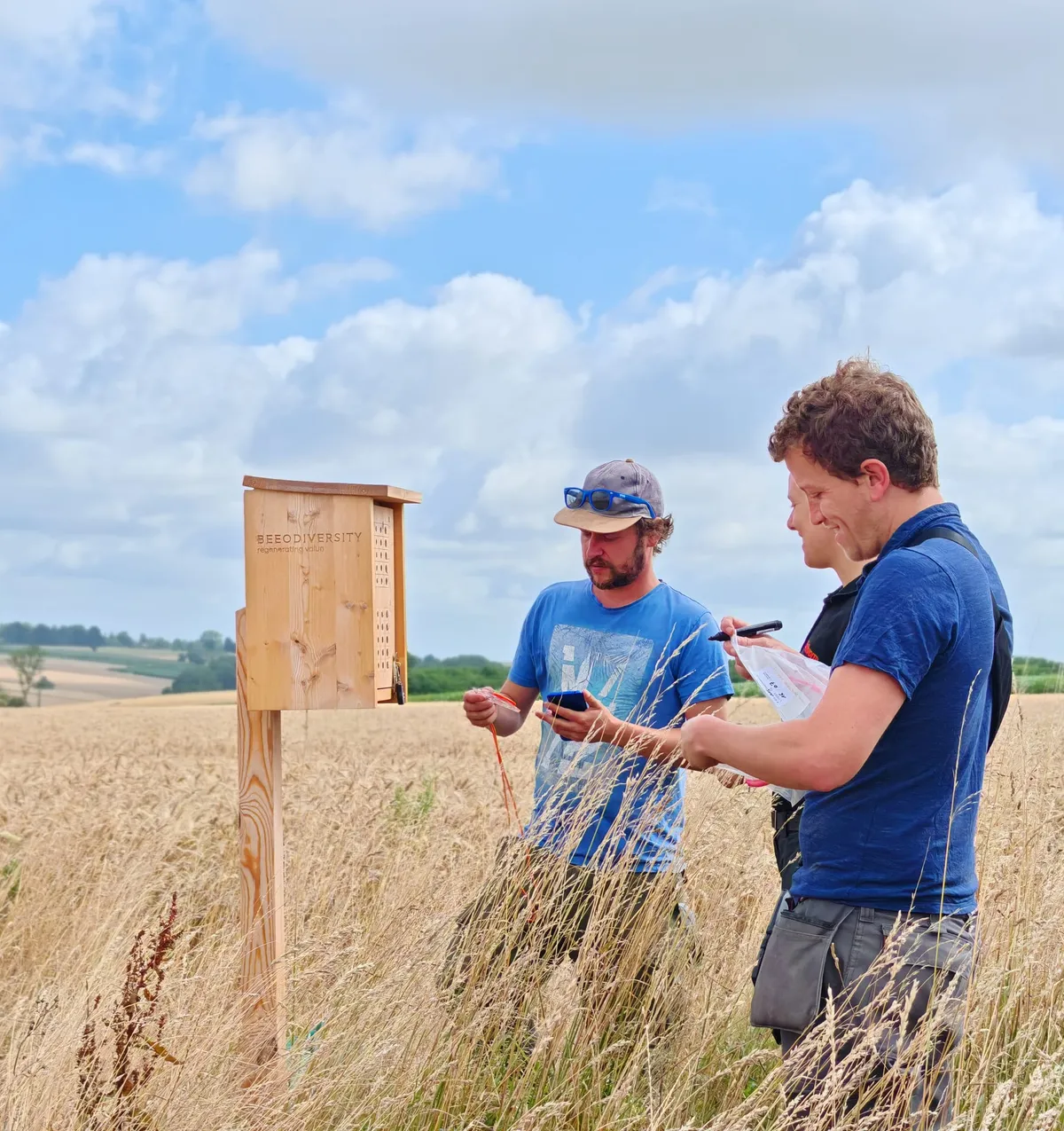
Agriculture depends on nature — and on farmers. Pollination, soil fertility, pest regulation, and water retention are the ecosystem services that sustain crop resilience, yield, and quality.
Yet intensive practices have eroded them, putting both environmental and economic sustainability at risk.
At the same time, farmers are the front line of the transition: their livelihoods, their knowledge, and their willingness to change determine whether regenerative ambitions become reality. Food and beverage companies, cooperatives, and public authorities need to recognise farmers who act positively and support them — including financially — with science-based indicators that are relevant, scalable, and affordable across supply chains. BeeOdiversity combines field-based monitoring, strategic consulting, and action management to help you measure what matters, engage your value chain, and demonstrate credible progress — for nature and for the people who work with it.
Where biodiversity matters for agriculture & agri-food
Biodiversity, soil health, and farmer livelihoods intersect with agricultural value chains at every level — from sourcing strategy to field practices and consumer trust.
Secure value chain resilience
60–80 % of crops depend on animal pollination, yet pollinator populations are declining sharply. Soil degradation reduces water retention, nutrient cycling, and natural pest regulation — increasing input dependency and production risk. Companies whose supply chains rely on agricultural raw materials face growing exposure to yield volatility, quality loss, and sourcing disruption. Farmer livelihoods are equally at stake: when ecosystem services decline, input costs rise and yields fall — threatening the economic viability of the producers you depend on. Improving biodiversity and soil health can increase yields, open additional revenue streams (pollination services, carbon credits, beekeeping), and strengthen producer retention across your sourcing network. Understanding where ecosystem services are under pressure is the first step to protecting them — and to securing the farmers who deliver them.
Deploy regenerative agriculture at scale
Many companies have committed to regenerative agriculture — but does it actually deliver? Without relevant, field-level indicators, it is difficult to know whether practices are changing, whether soil health is improving, or whether biodiversity is recovering. The need is not just to implement regenerative practices, but to validate that they produce real, measurable environmental and agronomic outcomes. Scaling the transition means giving farmers tools they can use, data they can trust, and support that connects sustainability ambitions with agronomic reality — proving that what works for biodiversity also works for crops and for farmers' income.
Identify agricultural pollutants & act in a targeted way
Pesticides, heavy metals, and nitrates circulating across agricultural landscapes can harm soil functionality, pollination, and broader ecosystem health — undermining the very services that sustain agriculture over the long term. Beyond the field, these pollutants put pressure on surrounding water bodies, air quality, and natural habitats. Identifying which pollutants are present, assessing their origin and their impact on ecosystem services, is the foundation for targeted action: reducing exposure where it matters most, advising on alternatives, and engaging farmers in the transition. Acting on agricultural pollutants also means responding to growing pressure from regulators, retailers, and civil society — and providing transparent evidence of sustainable practices to consumers who demand proof, not promises.
Strengthen brand value & meet reporting requirements
CSRD (ESRS E4) requires disclosure of biodiversity impacts and dependencies across the value chain. The EU Taxonomy, TNFD, and sustainability certification schemes (SAI Platform, Regenerative Organic Certified) demand verifiable environmental data from field to brand. Investors, retailers, and consumers expect traceability and proof — not just commitments. Transparent monitoring data is the foundation for credible sustainability claims, product differentiation, and stakeholder trust.
From data to action: how BeeOdiversity delivers
BeeOdiversity is a unique partner combining nature-based monitoring, strategic consulting, and operational action management — from corporate strategy down to the individual farm. We help agri-food actors move from ambition to measurable impact, with science-backed data that farmers, brands, and regulators trust.
Strategy & prioritisation
Understand — Prioritise — Plan
Screen your sourcing areas and farming territories using satellite imagery and AI-driven geospatial analysis to identify where biodiversity and soil health risks are highest. Our consultants then build on this data to deliver a full nature strategy: materiality assessment, site and territory prioritisation, regenerative roadmap with KPIs, and regulatory alignment.
BeeOimpact
Prioritise farms and sourcing territories based on their exposure to biodiversity and pollutant risks — proximity to sensitive areas, ecosystem pressures, crop dependencies. Screen thousands of sites remotely, at low cost, and focus monitoring and support where it matters most.
BeeOconsult
From biodiversity risk assessments to regenerative agriculture roadmaps. Materiality analysis, sourcing strategy, stakeholder engagement workshops with farmers and cooperatives, and alignment with CSRD, TNFD, SAI Platform, and certification schemes.
Our agronomists also assist in improving farming practices (itinéraires techniques) towards more sustainable approaches and train farmers on biodiversity-positive techniques — bridging corporate sustainability goals with on-the-ground agronomic reality.
Monitoring & evidence
Measure — Detect — Demonstrate
For priority territories, we deploy nature-based monitoring solutions that go beyond inventory: they generate the field-level evidence you need to support farmers in the transition, demonstrate progress to stakeholders, and ground your regenerative claims in science.
BeeOmonitoring
Obtain plant diversity data and ecosystem pollinator health data at territorial level — 700 ha (1,800 acres) — to take well-targeted actions that improve local pollination and measure the positive impact of management and planting actions over time.
Identify agricultural pollutants (pesticides, heavy metals, nitrates) circulating across the landscape, assess their origin and impact on ecosystem services, advise on alternatives, and raise awareness among farmers and stakeholders — so you can act in a focused way rather than relying on blanket measures.
BeeOtel
A scalable, low-cost device deployable across many farms to assess pollinator presence and biodiversity at parcel level — 40 ha (100 acres). Rank and compare fields, identify where pollinators are thriving and where intervention is needed.
Engage farmers through a participatory approach — they see their own data, understand the link between practices and pollinator health, and become actors of the transition rather than subjects of reporting.
BeeOsoil
Soil is the foundation of agricultural productivity — yet conventional soil analyses miss the biological dimension. eDNA-based analysis reveals soil functionality: water retention, carbon sequestration, nutrient availability (nitrogen, phosphorus), and natural pest regulation.
Compare soil health across farming systems, track the impact of regenerative practices over time, and generate the indicators that link soil biodiversity to agronomic performance — less fertiliser, better infiltration, fewer diseases.
BeeOsurvey
On-site ecological inventories by our Suitably Qualified Ecologists — establishing baselines on habitat quality, species richness, and ecological connectivity across farms and sourcing territories.
Identification of pollinator species, beneficial insects, and ecological infrastructure (hedgerows, buffer strips, wetlands) — the field-level data that grounds regenerative strategies in agronomic reality.
Actions & reporting
Act — Track — Communicate
Turn monitoring data into measurable impact across your value chain — through a combination of expert agronomic guidance and a centralised action management platform.
Ecological expertise
Our ecologists and agronomists design farm-specific interventions: pollinator habitats, hedgerow and buffer strip restoration, cover cropping strategies, pesticide reduction pathways, and soil regeneration plans.
Co-construction workshops with farmers and cooperatives to align sustainability objectives with agronomic reality — because the real challenge is bringing farmers on board with practices that work for them and for biodiversity.
BeeOinitiative
Define site-level objectives, select from 60+ agriculture-specific initiatives scored by biodiversity impact (1–5) and cost, and track implementation across all your farms and sourcing territories with standardised KPIs.
Each territory has its own dashboard — initiatives, progress, timelines, budgets. Aggregated metrics aligned with SAI Platform, Regenerative Organic Certified, and CSRD reporting requirements. Export directly into your sustainability reports.
Regulatory alignment
Our solutions support compliance with the frameworks that matter to agriculture and agri-food.
CSRD / ESRS E4
Mandatory biodiversity and pollution disclosure across the value chain
EU Taxonomy
Do No Significant Harm biodiversity criteria for agricultural activities
TNFD
Nature-related financial disclosure for food and agriculture sectors
SAI
Farm Sustainability Assessment and regenerative agriculture frameworks
ROC
Soil health, animal welfare, and social fairness standards
SBTN
Science-Based Targets for Nature, including land use and freshwater
VSME
Voluntary Sustainability Reporting Standard for non-listed SMEs in the food chain