
eDNA analysis · Soil functionality · Tailored to your challenges
BeeOsoil
Understand what lives beneath the surface — and what it means for your operations. BeeOsoil uses environmental DNA to assess soil biodiversity and functionality, tailored to your specific challenges: water retention, nutrient cycling, disease control, carbon sequestration, and more. No off-the-shelf indicators — only the ones that matter to you.
Why BeeOsoil
Four reasons it creates business value.
What you get
Concrete outputs you can act on.
Data
Soil biodiversity
Fungi · Bacteria · Arthropods · Annelids
Richness, relative abundance, community composition — identified via eDNA
Soil functionality indicators
Tailored to your challenges: Water retention & infiltration · Carbon sequestration · Nutrient cycling (N, P, K) · Disease control · Organic matter cycling
Each indicator is built from targeted bioindicator microorganisms, selected specifically for your site context.
Comparative analysis
- Baseline definition (T0) and year-on-year comparison
- Cross-site comparison (e.g. conventional vs. regenerative vs. natural reference)
- Benchmarking across management practices
Reporting & interpretation
- Full PDF report with all indicators, interpretation by our soil and agronomy experts, and actionable recommendations
- Geo-referenced sampling maps and parcel-level data
- CSRD / TNFD / SBTN / SAI aligned data export for regulatory disclosure
- Option to combine with physicochemical soil analyses (pH, NPK, moisture, C/N) for a complete soil profile
Agronomic recommendations
- Prioritized on-site recommendations from our agronomists, based on soil analysis findings
- Practice-specific guidance: tillage reduction, crop rotation, fertilizer reduction, cover cropping
- Link between soil functionality and productivity outcomes (yield, resilience, input reduction)
The process
Tailored from the start. Science-based throughout.
Unlike standard soil assessments, BeeOsoil does not apply a one-size-fits-all protocol. Because soil biodiversity varies dramatically depending on where you sample, when you sample, and what management practices are in place, we co-design the entire approach with you — before any fieldwork begins.
Needs workshop
We run a collaborative workshop with your team to identify your specific soil-related challenges & objectives: water retention, disease pressure, nutrient availability, carbon sequestration, or other priorities. This step is essential — it ensures every analysis produces data you can actually use.
Protocol & indicator design
Based on your objectives, crops, site conditions and management practices, we define the bioindicator microorganisms to target and design a tailored sampling protocol. No generic species lists — only the organisms that form the functional indicators relevant to you.
Sampling & eDNA analysis
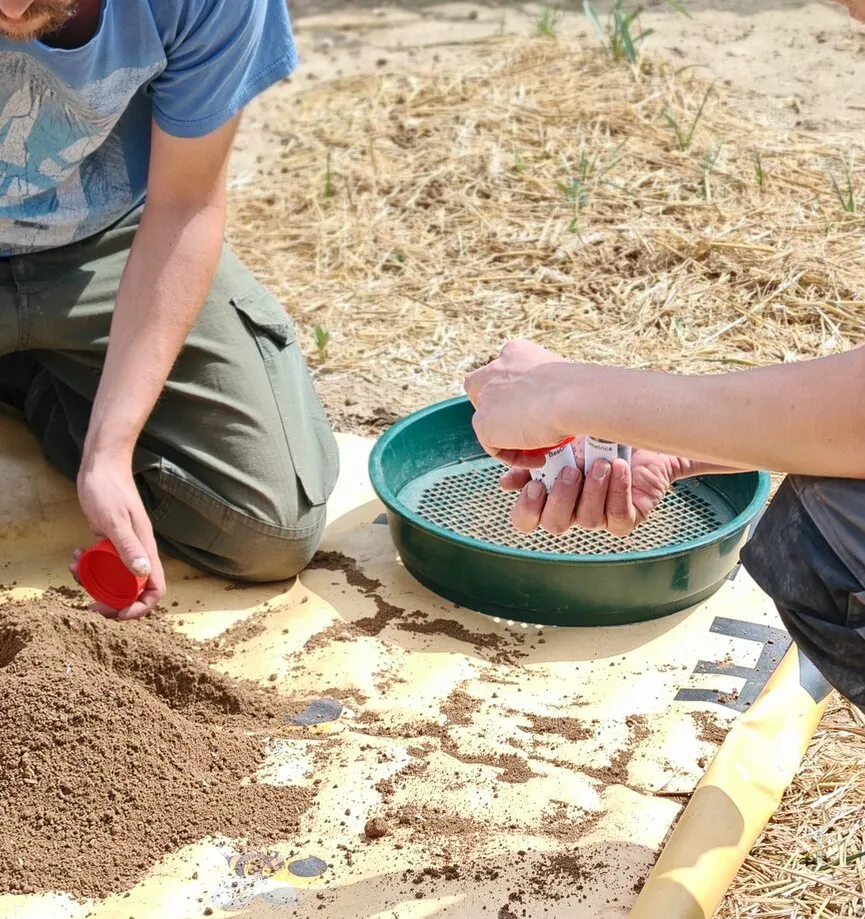
Soil samples are collected according to the co-designed protocol. Our laboratory analyses environmental DNA to identify and quantify the targeted microorganisms — fungi, bacteria, arthropods, annelids — and compute your functional indicators.
Report & agronomic expertise
You receive a detailed report with all indicators, expert interpretations and findings from our agronomists and soil scientists, and a prioritized set of recommendations to improve soil health and functionality. Data is structured for CSRD, TNFD, SBTN, SAI and other relevant frameworks.
Who uses BeeOsoil
Designed for organisations whose activities depend on — or impact — soil health.
Agri-food & Supply chains
Regenerative agriculture performance
Quantify whether your transition to regenerative practices is improving soil health — with functional indicators that go beyond simple species counts. Evidence impact for buyers, investors and certification bodies.
Water producers
Soil-water nexus monitoring
Monitor the potential capacity of soils in your catchment area to filter water, retain nutrients and resist erosion. Link soil functionality data to water quality outcomes.
Industry & Extraction
Site restoration & remediation verification
Verify that restoration efforts on post-industrial or extraction sites are rebuilding healthy, functional soil ecosystems — not just green cover.
Nature restoration actors
Restoration outcome measurement
Measure whether your restoration projects are restoring below-ground ecosystem functions, not just above-ground vegetation. Track progress from baseline to target.
Compliance & reporting
BeeOsoil data feeds directly into your regulatory reporting.
CSRD / ESRS E4
Biodiversity & ecosystems disclosure
TNFD
Nature-related financial disclosures
SBTN
Science-based targets for nature
SAI
Complete your approach
BeeOsoil works best with…
Bee data · Landscape level · Biodiversity & pollution
BeeOmonitoring
Combine below-ground soil analysis with above-ground landscape monitoring. BeeOmonitoring tracks plant biodiversity and pollution across 700 ha — giving you the full picture from soil to ecosystem.
Wild bees · Biodiversity & pollution
BeeOtel
Add parcel-level pollinator monitoring to your soil assessment. Wild bee occupancy data complements soil functional indicators for a complete ecosystem health view.
Strategy · Field expertise · All scales
BeeOconsult
Turn your soil and biodiversity data into a full sustainability strategy. Our experts build the roadmap aligned with CSRD, TNFD and regenerative agriculture frameworks.