
Regenerative Agriculture: turning agricultural transition into measurable outcomes for all stakeholders
AI generated
What is regenerative agriculture and why does it remain unclear?
So what is regenerative agriculture in practice? Regenerative agriculture1 is a farming approach that works with natural processes to improve ecosystem functions such as soil health, biodiversity, nutrient cycling, etc.
Unlike nature restoration, which aims solely to restore ecosystems regardless of agricultural outcomes, regenerative agriculture focuses on making agricultural systems healthier and more resilient while also maintaining or increasing farm profitability.
As discussed in our previous article, agricultural practices exist along a sustainability continuum, from conventional to regenerative practices.
And like any meaningful sustainability transition, regenerative agriculture cannot rely on intentions alone. It requires:
- Clear objectives to define what progress means for different stakeholders;
- Relevant indicators to track improvements in soil health, biodiversity, and system resilience;
- Targeted actions implemented step by step to generate long-term impact.
Credits : Van3ssa
1 – Regenerative Agriculture—A Literature Review on the Practices and Mechanisms Used to Improve Soil Health – MDPI
Yields, costs reduction, product quality: start with the objective of your regenerative project
- Farmers are often focused on reducing costs, managing risks, and ensuring income stability. Practical objectives tied directly to day-to-day farm operations.
- Companies and brands may have different or even opposing objectives, such as improving product quality, enhancing supply chain resilience, or achieving carbon reductions. They also decide how regenerative agriculture is positioned externally. Including the level of visibility and storytelling, often influenced by consumer expectations and investor pressure.
- Marketing teams pursue a related but distinct set of objectives, focusing on brand image, consumer engagement, and communication. This often involves highlighting certifications, indicators, and headline numbers across multiple initiatives. Which can sometimes overemphasise visibility compared to what is concretely happening on the ground.
Measuring the success of regenerative practices: from objectives to indicators
Here are some illustrative and non-exhaustive mappings of objectives to possible indicators:
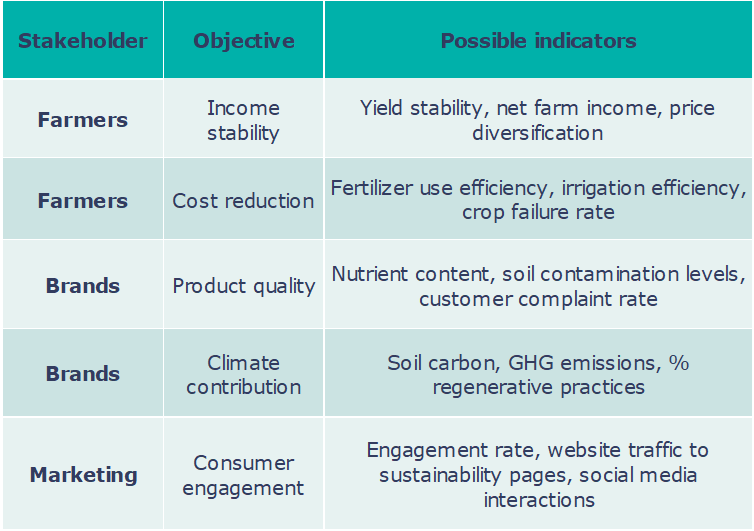
Stakeholder objectives & indicators, BeeOdiversity 2026
The why of the regenerative farming action
Evidence from the Sustainable Agriculture Initiative (SAI) Platform’s Regenerating Together Framework2 highlights strong links between regenerative practices and multiple outcomes.
To boost soil health and fertility in particular, the report identifies the most impactful practices:
- Minimising soil disturbance through reduced or zero-tillage practices;
- Controlled traffic (restricts soil compaction to precise traffic lanes of machinery);
- Cover cropping (plants that cover the soil in between cash crop seasons);
- Manure management (compost or animal dung used as fertilizers);
- Irrigation management.
The same action can also influence multiple objectives. For example, planting hedgerows and green buffers can impact the following:
- Soil health and fertility;
- Habitat provision;
- Greenhouse gas emissions.
Different outcomes may call for different combinations of practices. Some deliver broad, system-wide benefits, while others are especially effective at addressing specific sustainability goals.
2 – SAI Platforms Regenerating Together: Framework Linking Practices and Outcomes – PDF
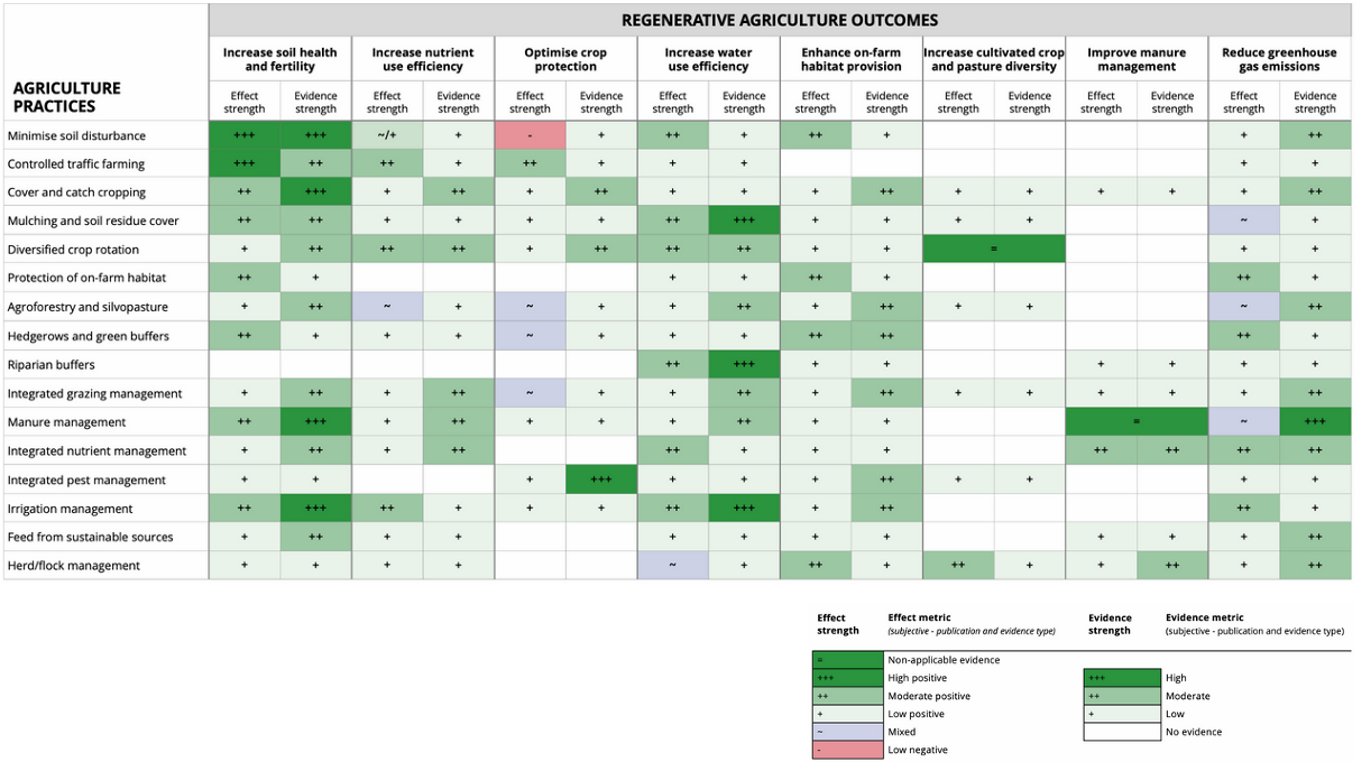
3 – SAI Platforms Regenerating Together: Framework Linking Practices and Outcomes – PDF
Regenerative agriculture: a journey with gradual progress over time
4 – Soil Organic Carbon and the Long-Term Impact of Regenerative Practices – PubMed
5 – Soil Microbial Biomass Recovery under Regenerative Farming – PMC
The positive side is that progress is measurable each year:
- Organic matter and soil carbon increase incrementally with cover crops, compost, and manure applications.
- Soil structure and water retention improve season by season, helping crops and biodiversity thrive.
- Microbial and nutrient activity steadily build, laying the foundation for long-term resilience.
Even though full soil recovery may take time, every year of regenerative practice delivers tangible improvements.
A practical example of the importance of setting objectives in regenerative agriculture
Long-term studies6 show that the use of cover crops can increase soil organic carbon by approximately 0.1 to 1 tonne of carbon per hectare per year, while raising soil microbial abundance by around 25–30 % and microbial activity by more than 20 %. These improvements in soil biology translate into tangible agronomic benefits, including improved nutrient cycling, greater plant resilience and reduced erosion, with runoff reductions of up to 80 % reported in some systems.
6 – Transformative Action Towards Regenerative Food Systems: A Large-Scale Case Study – PLOS Sustainability and Transformation
7 – Cover Crops Enhance Soil Organic Carbon and Soil Quality for Sustainable Crop Yield: A Systematic Review – MDPI (Agronomy)
Importantly, biodiversity gains are directly linked to agronomic goals like pest control and resilience, making it a strategic lever rather than a side benefit.
Regenerative agriculture in practice with BeeOdiversity
At BeeOdiversity, regenerative agriculture is not a one-size-fits-all concept, it is a co-constructed journey grounded in science and measurable outcomes.
In our webinar with Nestlé and partners, we explored how regenerative ambitions can be translated into operational reality. Together with clients and stakeholders, we co-design tailored frameworks that define:
- Clear biodiversity and soil health indicators
- Step-by-step implementation rules adapted to local contexts
- A robust monitoring protocol to establish a reliable baseline
- Measurable impact tracking to assess progress over time
This collaborative process typically takes place through interactive workshops, where we align expectations, define proper indicators with our partners, and ensure that implementation remains both scientifically sound and operationally feasible.
One concrete example of this approach is our work using biomonitoring tools to support more targeted and efficient pesticide use.
For one client, we implemented a BeeOmonitoring program to assess environmental pressure and trigger a change in agricultural practices. Through scientific data collection and impact analysis, we were able, together with farmers, to reduce pesticide use, by up to 80% on one site.
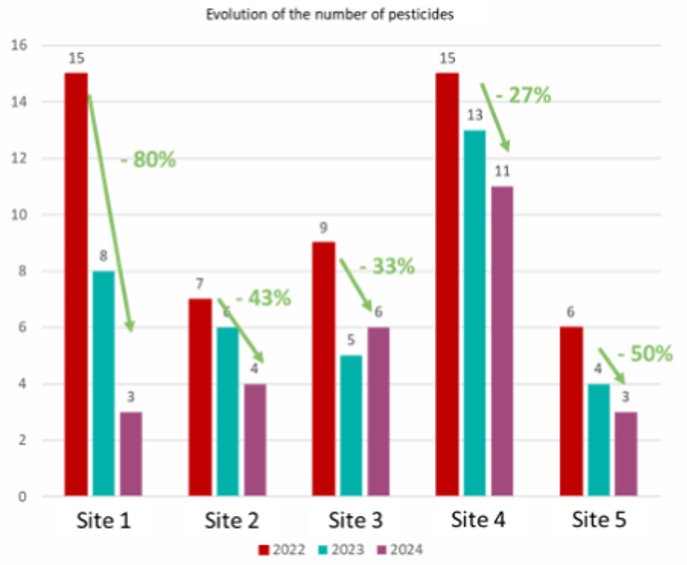
Importantly, this was not about eliminating pesticides overnight. Instead, the objective was to move from systematic application to precise, data-driven intervention.
Through a series of workshops with farmers, we:
- Shared BeeOmonitoring results in an accessible and transparent way
- Explained the impact of certain pesticides on biodiversity, soil health, and crop resilience
- Identified opportunities to optimize treatment timing and dosage
One key action was the installation of a local weather station to feed accurate meteorological data into a prediction and alert model. This allowed treatments to be carried out only when strictly necessary, rather than systematically.
The result?
- Significant reduction in pesticide use
- Lower input costs and reduced time spent in the field
- Maintained (and potentially improved) crop yield
- Enhanced soil health and ecosystem resilience
By grounding regenerative agriculture in field data and farmer engagement, we support a transition that is both environmentally meaningful and economically viable.
Conclusion: from measurements to meaningful changes of agricultural practices
When it comes to regenerative agriculture, progress comes from focusing on the right objectives, indicators, and actions. Each stakeholder (farmers, companies/ brands, marketing teams) may have different priorities, and trying to address everything at once can be overwhelming.
The strength of this approach lies in aligning actions with diverse objectives. While designing effective practices and indicators can be complex, collaboration and guidance make the transition achievable.
Fill in the form an we will get back to you soon.
BeeOdiversity develops projects in several European countries, Switzerland and the United States. Its tools and services can be used the world over.
To contact us from Belgium and abroad : +32 2 428 00 82
Head office :
Avenue Arnaud Fraiteur 15-23
1050 Brussels, Belgium
Like the idea of working with us ?



0 Comments